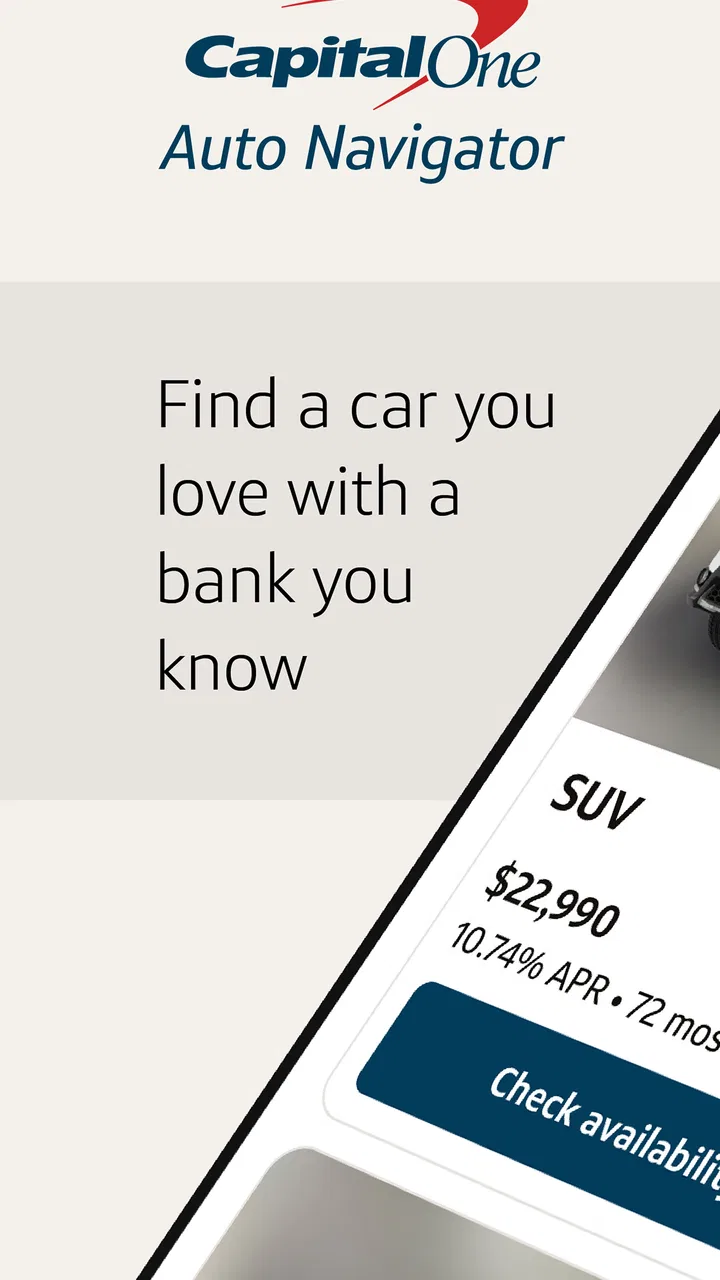
Auto Navigator New & Used Cars
- 4.7
- Rating
- 100.00K
- Installs
- Free
- Price

 Analysis by App-foxy
Shopping for a vehicle is already a demanding task, and it becomes even harder when the process involves several websites, financing questions, saved searches, and dealership visits. Auto Navigator New & Used Cars takes a more focused approach: it brings vehicle discovery and Capital One financing information into the same mobile experience. I found it most useful as a planning tool rather than as a complete replacement for every part of buying a car.
The app is free, belongs to the Auto & Vehicles category, and is developed by Capital One Services, LLC. Its store summary is “Shop cars & see your financing,” which accurately describes the central idea without explaining how that idea feels in everyday use. The application has a 4.5 average from around 4.4 thousand ratings, with more than 100 thousand installs, so it has attracted a meaningful audience without feeling like an obscure experiment.
How clearly the app supports different users and situations
I look at how the app’s connected car search and financing approach can serve people with different needs, routines, and levels of confidence. A useful next step is to decide in advance what information you need to compare and who should help review it, so the convenience of a shared mobile workflow supports your decision rather than taking it over.
You May Also Like

 Google Keep - Notes and lists
Google Keep’s Quiet Growth Shows the Appeal of Simpler Notes
As mobile work gets busier, Google Keep keeps winning a simple contest: capture a thought quickly, find it later, and get on with the day.

 Blood Strike: 2.5 Anniversary
Blood Strike’s Loadouts Turn Every Drop Into a Tactical Gamble
A close look at Blood Strike’s custom loadouts: how fast access to signature weapons reshapes its battle royale rhythm, rewards preparation, and narrows the gap between fights.

 Pandora - Music & Podcasts
Pandora’s Music Is Easy to Start, but Harder to Recover
Pandora’s strength is its low-effort path from a seed to a station. Its weak spot is how much confidence it asks you to place in connection, setup, and quiet recovery.

 8 Ball Pool
 Is Built on Rivalries, Rematches, and Routine
A close look at the rivalries, rematches, shared routines, and unanswered safety questions that turn a quick pool match into a persistent mobile community.

 Samsung Music
’s Quiet Strength Is Playing What You Already Own
Its reach comes less from spectacle than from dependable access to a personal library. That simplicity is both the app’s strongest retention engine and its ceiling.

 AccuWeather: Weather Radar
AccuWeather Review: A Quick, Clear Forecast for Everyday Decisions
For everyday plans, the best forecast is the one you can understand quickly. AccuWeather makes rain timing, radar, and local conditions easy to act on, with a few trade-offs.
More From Our News Desk



Readability and navigation during a car search
My first impression is that the app’s purpose is easier to understand than the wider car-buying process. Instead of opening with a maze of unrelated financial products, it puts the vehicle search and financing context close together. That matters when I am comparing cars and do not want to keep switching between a shopping site, a calculator, and a separate account screen.
The most helpful way to use it is to begin with a realistic shortlist rather than browsing endlessly. I would decide on a general body style, an acceptable age range, and a payment comfort zone before opening individual listings. This makes the app feel less overwhelming and reduces the temptation to treat every attractive vehicle as a serious option.
For readers who rely on larger text, strong contrast, or a simplified visual layout, the experience will depend heavily on the phone’s own display settings and the way each screen presents its content. I found the general flow easier to follow when I concentrated on one task at a time: search first, inspect a vehicle second, and consider financing only after deciding whether the car itself makes sense.
The clearest strength is the connection between browsing and financial preparation. A normal classifieds platform may show many cars but leave the buyer to work out the financing separately. A bank app may show financial information but offer little help with choosing a vehicle. Auto Navigator sits between those two approaches, which can reduce mental switching for someone who wants a single starting point.
That does not mean every user will find the interface effortless. Car listings naturally contain many details, and comparing several vehicles on a small screen can require repeated back-and-forth movement. I recommend taking notes outside the app or saving only the strongest candidates instead of trying to remember every specification from a long browsing session.
Motor and sensory considerations
Using a phone for vehicle shopping can be physically tiring. Scrolling through listings, tapping small controls, and moving between search results and details may be uncomfortable for people with limited dexterity or hand fatigue. I would use the app in shorter sessions, keep the phone on a stable surface, and rely on the device’s built-in voice control or magnification tools when those are already familiar.
The app is also not something I would evaluate only by asking whether it has a clean appearance. A buyer may be using it while sitting in a noisy dealership, dealing with glare in a parking lot, or sharing the screen with another person. In those situations, a visually busy listing or a small piece of financial information can be harder to interpret than it seemed at home.
For users with hearing-related access needs, the central shopping workflow is naturally more visual than an audio-dependent service, which is helpful in principle. Still, the important question is whether every meaningful instruction, status message, and action is understandable without relying on sound. I would not assume that a visual interface automatically solves every sensory barrier; I would check each step personally on the device being used.
People with cognitive or attention-related needs may appreciate the narrow purpose of the app, but vehicle buying remains full of unfamiliar terms and high-stakes choices. I found it easier to pause after each candidate and ask three practical questions: would I want this vehicle without the financing angle, can I afford the full ownership cost, and do I understand what the next step requires? That routine prevents the app’s convenience from rushing the decision.
Using it at home, in transit, and at the dealership
A realistic use case is a buyer who has a limited lunch break and wants to narrow down options before visiting a dealership. I would search from home, identify a few vehicles that fit the intended use, review the financing context, and then arrive with specific questions rather than starting from zero. This is where the app feels genuinely practical: it can turn an unstructured shopping trip into a prepared conversation.
It can also help when two people are making the decision together. One person can handle the vehicle preferences while the other focuses on whether the financing information fits the household budget. That division is useful for couples, family members helping an older relative, or anyone who finds it difficult to process vehicle and money details simultaneously.
In a dealership, however, I would avoid treating the phone screen as the final authority. The app can support preparation and comparison, but the buyer still needs to inspect the actual vehicle, ask about its condition, and read the documents presented during the transaction. A listing that looks suitable at home may feel different once I see its size, seating position, controls, or entry height in person.
Situational access also includes time pressure. Someone who is tired, anxious, or under pressure from a salesperson may miss an important distinction between browsing information and a commitment. My advice is to use the app before the appointment, not as a reason to make a rushed decision during it. A calm shortlist is more valuable than a large collection of impulsive favorites.
Where the experience still creates barriers
The biggest limitation is that combining shopping with financing can make the process feel simpler than it really is. A convenient path from a vehicle to financing is useful, but it should not replace independent thinking about insurance, fuel, maintenance, taxes, registration, accessibility equipment, and the total cost of ownership. The app helps with one part of the decision; it does not make the whole decision for me.
Another barrier is suitability. The experience is naturally more relevant to people who are comfortable considering Capital One financing as part of their search. If I already have a preferred lender, need specialist advice, or want to compare a broad range of finance providers in one place, a general car marketplace and a separate loan comparison process may offer more flexibility.
It is also not the right primary tool for someone who needs a highly detailed vehicle-history investigation, an in-person mechanical inspection, or deep research into modifications. I would pair it with an independent inspection and document review before buying. That is especially important for used cars, where appearance and monthly payment can distract from condition.
Users with accessibility needs should also remember that the car itself matters as much as the app. A searchable vehicle may still be unsuitable because of seat height, door weight, steering effort, pedal arrangement, visibility, or space for mobility equipment. I would use the application to narrow the field, then test the exact vehicle with the person who will drive or ride in it.
For readers who prefer a desktop monitor, paper notes, or help from a family member, the mobile format may feel restrictive. A larger screen can make side-by-side comparisons and document reading more comfortable. In my experience, the best workflow is hybrid: use the phone for quick discovery and portability, then move to a larger screen or printed notes when the decision becomes serious.
Practical ways to make the app more inclusive
I recommend adjusting the phone before starting rather than trying to solve every problem mid-search. Increase text size if needed, reduce glare, enable the device’s preferred contrast or color settings, and keep the phone charged before a dealership visit. These small preparations matter because a car search can easily last longer than expected.
For people with limited hand movement, voice input can reduce repeated typing when searching, while a stylus or a stable stand may make tapping more manageable. I would also avoid browsing while walking or riding in a car. Stopping in a safe place makes it easier to read financial information accurately and prevents situational distractions from becoming an access problem.
For someone assisting another buyer, I would create a short written checklist outside the app: vehicle, mileage, condition questions, estimated total budget, and next action. This keeps the conversation focused and gives the buyer a way to participate without having to remember every screen. It also makes it easier to notice when the search has drifted away from the original needs.
One less obvious benefit of this approach is emotional accessibility. A person who feels intimidated by dealerships can use the app to learn the vocabulary of the search and arrive with a defined purpose. That does not remove sales pressure, but it can make the first conversation less unequal. Preparation is particularly valuable for first-time buyers and people who need extra time to process choices.
At the same time, I would not use a prefilled or convenient finance path without reading each stage carefully. If a screen asks me to continue, review, or submit something, I pause and identify whether I am still exploring or moving toward a formal application. That distinction is easy to blur when the shopping flow is smooth.
Version, availability, and who should choose it
The app was released on April 6, 2021, and its current version is 2026.03.04. It requires iOS or Android 11 or newer, so anyone using an older phone should check compatibility before planning around it. The Everyone content rating makes it suitable for general audiences, although the financial decisions inside the app are still adult responsibilities even when the app itself is broadly rated.
I think it is a strong fit for a buyer who wants to explore new and used cars while keeping financing visible during the search. It is especially useful for someone preparing for a dealership visit, comparing a manageable shortlist, or trying to make the process less fragmented. The free price also makes it an easy tool to try before deciding whether it belongs in a larger buying workflow.
I would skip it as my main resource if I wanted a completely lender-neutral marketplace, a specialist accessibility vehicle service, or a full replacement for inspection and ownership research. In those cases, a general vehicle marketplace, an independent mechanic, a disability-focused mobility adviser, or a separate finance comparison tool may be better suited to the job.
My inclusive verdict after using it
Auto Navigator New & Used Cars is most successful when I treat it as an organized first step rather than a magic shortcut. It brings vehicle discovery and Capital One financing into a connected mobile experience, which can reduce confusion for many shoppers. Its practical value comes from helping me prepare, not from eliminating the need to inspect, compare, question, and slow down.
From an inclusive-use perspective, I appreciate that the app can support different routines: a quiet search at home, a shared decision with a family member, or a prepared visit to a dealership. The main barriers come from the density and importance of car-buying information, the physical demands of phone interaction, and the risk of confusing convenience with a complete financial answer.
I recommend it to people who want a clearer starting point for car shopping and financing, provided they keep independent checks in the process. Use the accessibility settings that already work for you, take breaks, compare only realistic candidates, and test the actual vehicle before committing. With that mindset, Auto Navigator New & Used Cars is a useful companion for the early and middle stages of buying a car, while the final decision still belongs to careful research and the buyer’s own needs.
FAQs for Auto Navigator New & Used Cars
01What is Auto Navigator New & Used Cars and how does it work?
Auto Navigator New & Used Cars is an app designed to simplify the car buying process by allowing users to browse a wide selection of new and used vehicles. The app offers detailed listings with photos, pricing, and vehicle specifications. Users can also apply for pre-qualification for financing directly through the app, making it easier to plan their budget.
02Is the app free to use or are there any hidden fees?
The Auto Navigator New & Used Cars app is free to download and use. There are no hidden fees associated with browsing car listings or applying for financing pre-qualification. However, users should be aware that purchasing a vehicle or securing financing will involve additional costs that are not covered by the app itself.
03Can I use Auto Navigator to compare different car models?
Yes, Auto Navigator allows users to compare different car models easily. You can view side-by-side comparisons of vehicle features, prices, and financing options. This feature helps users make informed decisions by providing a clear overview of how different models stack up against each other in terms of cost and specifications.
04Does Auto Navigator provide financing options?
Auto Navigator offers a seamless way to explore financing options through pre-qualification without affecting your credit score. The app connects users with various lenders, providing estimated monthly payments and interest rates based on your credit profile. This helps users understand their purchasing power before visiting a dealership.
05How accurate is the pricing information in the app?
The app strives to provide accurate and up-to-date pricing information by sourcing data directly from dealerships and financial institutions. However, prices may vary based on location and availability. It’s recommended to confirm pricing details with the dealership before making a final decision to ensure all information is current.
Pros
- User-friendly interface for quick browsing.
- Comprehensive vehicle history reports.
- Real-time financing options available.
- Personalized recommendations based on preferences.
- Secure login with multi-factor authentication.
Cons
- Limited inventory in rural areas.
- Some features require account creation.
- Occasional app performance lags.
- Advertisements can be intrusive.
- No direct dealer contact within app.

Auto Navigator New & Used Cars
Gallery